Have you ever picked up a water bottle, taken a sip, and wondered how much water it actually holds? It seems like a simple question, but walk into a supermarket or browse reusable drinkware online, and suddenly you’re surrounded by 12 oz, 16 oz, 20 oz, 32 oz, 40 oz, and even enormous gallon-sized bottles. Choosing one can feel surprisingly complicated.
Water is part of nearly every ordinary moment. It’s beside us during busy workdays, accompanies us on long road trips, sits on our gym benches, and becomes an essential companion during outdoor adventures. Yet the bottle holding that water matters more than we sometimes realize.
Understanding water bottle sizes makes it easier to choose the right capacity for your lifestyle. A small bottle might be perfect for a quick commute, while a larger insulated bottle could save you from repeatedly visiting the kitchen during a long work session.
In this guide, we’ll explore a practical water bottle size chart, compare ounces with milliliters and liters, examine common bottle dimensions, and explain which size works best for different activities.
Whether you’re shopping for a reusable bottle or simply curious about how many ounces in a water bottle, you’ll find the answers here.
| Water Bottle Size | Capacity (Ounces) | Common Use |
|---|---|---|
| Small Bottle | 8–12 oz | Kids, quick drinks |
| Standard Bottle | 16.9 oz | Everyday hydration |
| Medium Bottle | 20–24 oz | Gym and travel |
| Large Bottle | 32 oz | Workouts and outdoor use |
| Extra Large Bottle | 40–64 oz | Long trips and heavy hydration |
How Many Ounces Are in a Standard Water Bottle?
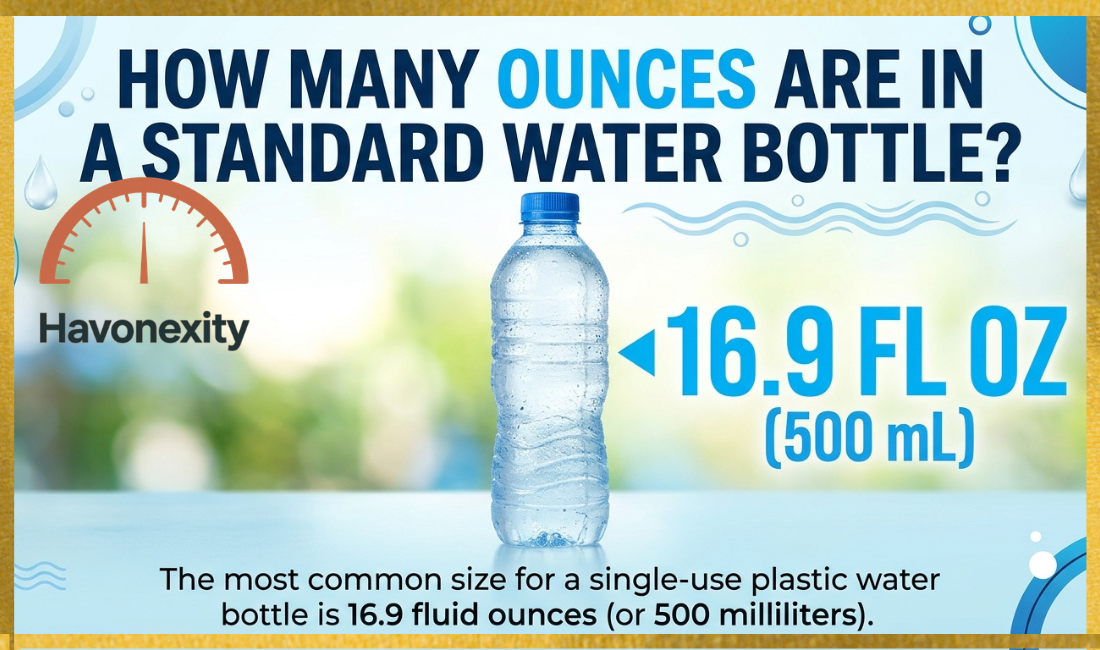
The answer depends on the bottle itself. There isn’t one universal standard that every manufacturer follows, although certain capacities appear much more frequently than others.
In the United States, a typical single-use bottled water container holds approximately 16.9 fluid ounces (500 mL). This is one of the most recognizable disposable bottle sizes.
Reusable bottles, however, come in a much wider range. Some are designed for children, while others are large enough to carry several servings of water.
Here are a few common examples:
- 12 oz water bottle: A compact option for children, short outings, and smaller bags.
- 16 oz water bottle: A convenient everyday size for light hydration.
- 20 oz water bottle: Popular for commuting, school, and general daily use.
- 24 oz water bottle: A practical choice for work, walking, and everyday activities.
- 32 oz water bottle: A larger option that reduces the need for frequent refills.
- 40 oz water bottle: Popular among people who want a substantial supply of water throughout the day.
- 64 oz water bottle: A half-gallon capacity suitable for longer outings and personal hydration goals.
- 128 oz water bottle: A full-gallon capacity designed for extended use or specific hydration routines.
The interesting part is that two bottles with the same capacity might look completely different. One may be tall and narrow, while another has a shorter, wider body. Capacity tells you how much liquid fits inside, not necessarily how much space the bottle occupies.
Water Bottle Sizes Chart: Complete Ounces and Milliliters Comparison
If you prefer measurements instead of guessing by appearance, a water bottle capacity chart is probably the easiest place to start.
The following chart compares popular bottle capacities in US fluid ounces, milliliters, and liters.
| Water bottle size | Milliliters (mL) | Liters (L) |
|---|---|---|
| 8 oz | 237 mL | 0.237 L |
| 12 oz | 355 mL | 0.355 L |
| 16 oz | 473 mL | 0.473 L |
| 16.9 oz | 500 mL | 0.5 L |
| 20 oz | 591 mL | 0.591 L |
| 24 oz | 710 mL | 0.710 L |
| 30 oz | 887 mL | 0.887 L |
| 32 oz | 946 mL | 0.946 L |
| 40 oz | 1,183 mL | 1.183 L |
| 50 oz | 1,479 mL | 1.479 L |
| 64 oz | 1,893 mL | 1.893 L |
| 80 oz | 2,366 mL | 2.366 L |
| 128 oz | 3,785 mL | 3.785 L |
Conversions are approximate and use US fluid ounces, not Imperial fluid ounces.
This chart is particularly useful when shopping internationally. For example, a bottle advertised as 750 mL holds approximately 25.4 US fluid ounces, even if its manufacturer doesn’t advertise the capacity in ounces.
Similarly, a 1-liter bottle holds approximately 33.8 fluid ounces.
One small detail worth remembering: fluid ounces measure volume, whereas ordinary ounces can also refer to weight. When comparing water bottles, always look for the abbreviation fl oz.
Understanding Common Water Bottle Sizes
Not every bottle is meant to accompany you from morning until bedtime. Different capacities serve different purposes, and understanding their differences can help prevent an unnecessary purchase.
8 oz and 12 oz Water Bottles: Small but Convenient
Small bottles are designed around convenience. They’re lightweight, easy to carry, and often fit into compact bags.
A 12 oz water bottle holds approximately 355 mL, making it suitable for children, short walks, or situations where carrying a larger container feels inconvenient.
Common uses include:
- Children’s school bags.
- Short shopping trips.
- Small handbags and backpacks.
- Quick errands.
- Desk-side drinking water.
- Compact travel arrangements.
These bottles aren’t necessarily ideal for an entire day outdoors, but their portability is a genuine advantage.
16 oz and 16.9 oz Water Bottles: Everyday Favorites
The 16 oz and 16.9 oz categories are especially familiar.
A 16 oz bottle contains approximately 473 mL, while a 16.9 oz bottle contains about 500 mL.
That difference might not look significant, but it’s useful when comparing American and metric bottle labels.
These sizes are commonly used for:
- Office desks.
- School and college.
- Short commutes.
- Everyday disposable bottled water.
- Lunch bags.
- Casual walks.
A standard 500 mL bottle is particularly easy to find in many countries, making it a convenient reference point when comparing other capacities.
20 oz Water Bottle: A Balanced Everyday Choice
This capacity offers a comfortable middle ground between compact portability and a reasonably generous water supply.
It works well for people who don’t want a tiny bottle but also don’t enjoy carrying a heavy container everywhere.
You might choose this size for:
- Daily commuting.
- Office work.
- College classes.
- Light exercise.
- Short outdoor activities.
- Road trips.
Is a 20 oz bottle enough for daily use? It can certainly contribute to your daily fluid intake, but whether one bottle is enough depends on your individual hydration needs.
24 oz Water Bottle: A Practical Middle Ground
It’s a useful option for people who drink water regularly throughout the day and prefer fewer refills than a smaller bottle requires.
This size is often available in plastic, stainless steel, and insulated designs.
A 24 oz bottle can be particularly helpful at work, during gym sessions, or when spending several hours away from home.
30 oz and 32 oz Water Bottles: More Water, Fewer Refills
Larger everyday bottles have become increasingly popular because they make hydration easier to organize.
A 30 oz bottle holds approximately 887 mL, while a 32 oz bottle holds approximately 946 mL.
The 32 oz bottle in liters is especially interesting because it holds almost one liter, although it isn’t exactly a liter.
These bottles are useful for:
- Gym workouts.
- Office routines.
- Hiking.
- Long study sessions.
- Outdoor activities.
- People who prefer fewer refills.
A 32 oz bottle can also be helpful for tracking water consumption. If you want to drink a certain amount throughout the day, you can count how many times you refill it.
40 oz Water Bottles: A Popular Large Capacity
A 40 oz bottle holds approximately 1,183 mL, or 1.18 liters.
It’s a substantial amount of water, particularly when carried in an insulated stainless steel container.
Many larger bottles include handles, wide openings, protective lids, and different drinking options.
This capacity works well for:
- Long office days.
- Extended gym sessions.
- Road trips.
- Outdoor activities.
- People who prefer larger hydration containers.
However, remember that a full 40 oz stainless steel bottle can become quite heavy. The empty bottle also contributes weight, so portability is worth considering.
50 oz and 64 oz Water Bottles: For Extended Hydration
A 50 oz bottle holds approximately 1.48 liters, while a 64 oz bottle contains almost 1.9 liters.
The 64 oz size is commonly described as a half-gallon bottle in the United States.
These larger containers can be useful for people who spend significant time outdoors, work in demanding environments, or want to keep a larger supply of water nearby.
They are not always the most convenient choice for commuting because they take up more room and can become heavy when filled.
80 oz and 128 oz Water Bottles: Extra-Large Options
Extra-large bottles are designed for people who need substantial liquid storage.
An 80 oz bottle holds approximately 2.37 liters, while a 128 oz bottle contains a full US gallon, equivalent to approximately 3.785 liters.
Common uses include:
- Camping.
- Extended outdoor work.
- Group activities.
- Sports training.
- Keeping water available at a workstation.
- Certain hydration routines.
A gallon bottle can be convenient at a stationary location, but carrying it around all day may become uncomfortable.
Ounces to Milliliters Conversion: How to Calculate Bottle Capacity
Understanding the conversion between ounces and milliliters makes comparing bottle labels much easier.
The basic conversion is:
1 US fluid ounce = 29.5735 milliliters
For everyday calculations, you can round this to 29.57 mL.
To convert ounces into milliliters, multiply the number of ounces by 29.5735.
For example:
20 oz × 29.5735 = approximately 591.47 mL.
To convert milliliters into ounces, divide the milliliter measurement by 29.5735.
For example:
500 mL ÷ 29.5735 = approximately 16.91 oz.
Here is another quick conversion reference.
| Fluid ounces | Approximate milliliters |
|---|---|
| 8 oz | 237 mL |
| 10 oz | 296 mL |
| 12 oz | 355 mL |
| 14 oz | 414 mL |
| 16 oz | 473 mL |
| 18 oz | 532 mL |
| 20 oz | 591 mL |
| 24 oz | 710 mL |
| 28 oz | 828 mL |
| 32 oz | 946 mL |
| 40 oz | 1,183 mL |
| 48 oz | 1,420 mL |
| 64 oz | 1,893 mL |
These calculations are useful when ordering bottles online, especially when product descriptions use different measurement systems.
Water Bottle Dimensions: Height and Diameter Explained
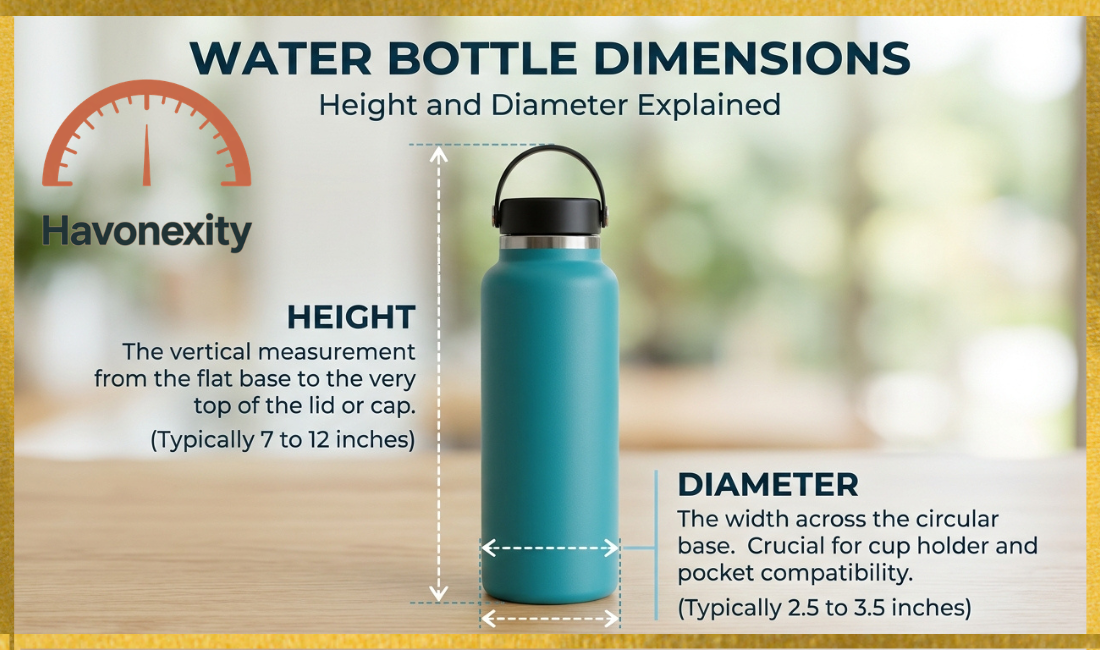
Capacity isn’t the only measurement worth checking before buying a bottle.
Two containers can hold exactly 32 oz but have very different shapes. One might be tall and slim, while another has a wider body and shorter height.
This is where water bottle dimensions become important.
The two most useful external measurements are:
- Bottle height: The distance from the bottom of the bottle to its highest point, usually including the lid.
- Bottle diameter: The width across the circular body of the bottle.
Approximate dimensions for common bottle capacities are shown below.
| Bottle capacity | Approximate height | Approximate diameter |
|---|---|---|
| 12 oz | 6–7 inches | 2–2.5 inches |
| 16 oz | 7–8 inches | 2.3–2.7 inches |
| 20 oz | 8–10 inches | 2.5–3 inches |
| 24 oz | 9–10.5 inches | 2.7–3.2 inches |
| 32 oz | 9–11 inches | 3–3.7 inches |
| 40 oz | 10–12 inches | 3–4 inches |
| 64 oz | 10–13 inches | 4–5 inches |
These are general illustrative ranges, not universal manufacturing specifications. Actual measurements vary by brand, shape, insulation, and lid design.
Why Bottle Height Matters
Bottle height becomes important when you’re choosing something for a backpack, refrigerator shelf, desk, or car.
A tall bottle might hold plenty of water but struggle to fit underneath a low kitchen cabinet.
Likewise, a wide bottle may be difficult to slide into a narrow backpack pocket.
Before purchasing, check the listed dimensions rather than relying entirely on the advertised capacity.
Why Bottle Diameter Matters
Diameter determines how much horizontal space a bottle occupies.
A bottle with a wide body may be stable when placed on a table, but it can become inconvenient when stored in a small bag.
For everyday commuting, a narrower design is often easier to manage.
Which Water Bottle Size Is Best for Different Activities?
The best water bottle isn’t necessarily the largest one available. It is the one that fits your routine without becoming another item you have to struggle with.
Best Water Bottle Size for the Gym
It provides a reasonable amount of water without occupying too much space in a gym bag.
People doing longer or more intense workouts may prefer a 40 oz bottle or access to a refill station.
Remember that exercise hydration depends on workout intensity, temperature, sweat loss, and individual needs.
Best Bottle Size for Hiking
You need enough water for the journey, but every additional ounce of equipment adds weight to your backpack.
A 20 oz, 24 oz, or 32 oz bottle may work for shorter walks, while longer hikes can require several liters of water depending on conditions and access to safe refill points.
For backpacking, consider a combination of lightweight bottles and a suitable water filtration system.
Best Water Bottle for Travel
Look for a leak-proof lid, durable construction, and a shape that fits comfortably inside your bag.
If you’re flying, remember that airport security rules generally restrict the amount of liquid you can carry through the screening checkpoint. An empty reusable bottle can usually be filled after screening, subject to airport rules.
Best Bottle Size for Work and Office
A medium or large bottle reduces repeated trips to refill stations while remaining manageable on most desks.
If you spend long periods working at a computer, having water within reach can also make drinking regularly easier.
Best Water Bottle for Camping
Camping often involves longer periods away from convenient drinking-water sources.
A 32 oz to 64 oz bottle can be useful, but the required amount depends on the weather, activity, available water supplies, and length of the trip.
For longer adventures, don’t rely on a single container. Carry enough water for your expected needs and have a reliable method of treating additional water when appropriate.
Reusable vs. Disposable Water Bottle Sizes
Water bottles generally fall into two broad categories: disposable and reusable.
Both serve a purpose, but they differ in construction, durability, cost, and convenience.
Disposable Water Bottles
Disposable plastic bottles are commonly available in capacities such as 330 mL, 500 mL, 750 mL, and 1 liter.
Their advantages include:
- Lightweight construction.
- Easy availability.
- Convenient single-serving portions.
- No need to carry the container home for repeated use.
However, disposable bottles create additional packaging waste when used regularly.
They are generally intended for single-use convenience rather than long-term daily hydration.
Reusable Water Bottles
Reusable bottles are available in numerous capacities, materials, and designs.
Popular materials include:
Stainless steel: Durable and frequently used in insulated bottles. Double-wall vacuum insulation can help maintain drink temperatures.
Plastic: Lightweight and convenient for everyday use. Some reusable bottles use BPA-free materials such as Tritan.
Glass: Offers a non-plastic drinking surface but can be heavier and more fragile.
Silicone: Commonly used in collapsible bottles, making storage easier when the bottle is empty.
A good reusable bottle should be easy to clean, comfortable to carry, and suitable for the type of liquid you intend to store.
What Is the Difference Between Insulated and Regular Water Bottles?
An insulated bottle is designed to slow down heat transfer between the liquid inside and the surrounding environment.
Many stainless steel models use double-wall vacuum insulation.
Regular plastic bottles generally don’t provide the same temperature retention.
Here is a simple comparison:
| Feature | Insulated bottle | Regular bottle |
|---|---|---|
| Temperature retention | Better | Limited |
| Weight | Usually heavier | Usually lighter |
| Material | Often stainless steel | Often plastic |
| Cost | Often higher | Often lower |
| Portability | Depends on design | Usually convenient |
| Best use | Travel, work, outdoor use | Everyday hydration |
An insulated bottle can be particularly useful during hot weather because it helps keep water cool for longer.
However, if you simply want an inexpensive container for drinking water throughout the day, a regular reusable bottle may be perfectly adequate.
How Much Water Should You Drink Per Day?
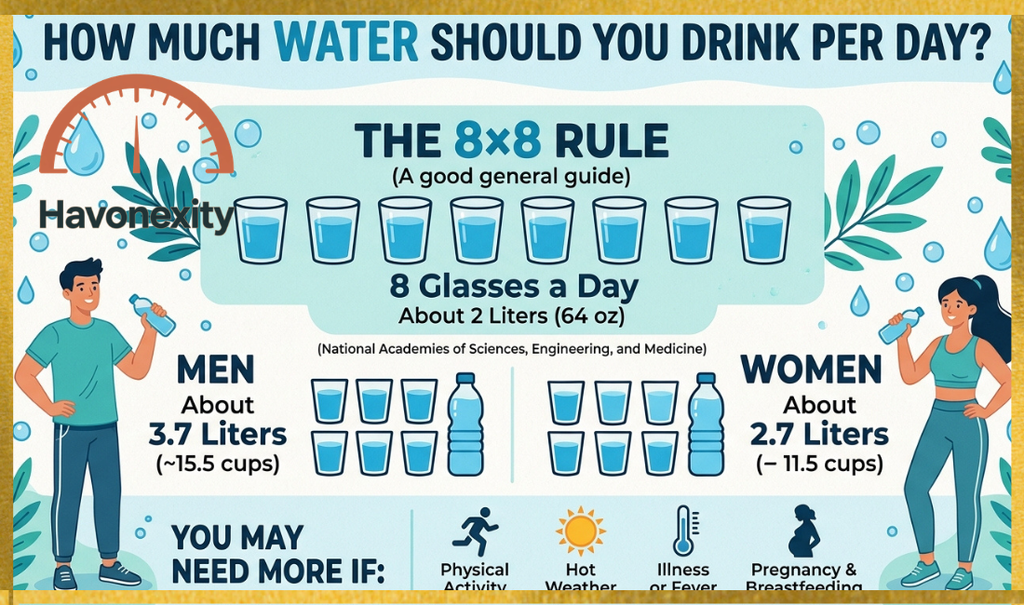
Choosing the right bottle size becomes easier when you understand your general hydration needs.
Water supports several essential bodily functions, including temperature regulation, digestion, circulation, and normal cellular activity.
However, there isn’t one exact daily water requirement that applies to everyone.
Fluid needs vary according to:
- Age.
- Body size.
- Physical activity.
- Climate and temperature.
- Pregnancy or breastfeeding.
- Overall health.
- Food and beverage consumption.
The US National Academies have published general adequate intake estimates for total daily water consumption:
- Approximately 3.7 liters per day for adult men.
- Approximately 2.7 liters per day for adult women.
These figures include water from all beverages and food, not just plain drinking water. Individual needs may be higher or lower.
For someone living in a hot climate, spending time outdoors, or exercising regularly, fluid requirements may increase.
How Bottle Size Can Help Track Hydration
A reusable bottle can make your daily drinking habits easier to observe.
For example:
- A 16 oz bottle holds approximately 473 mL.
- A 20 oz bottle holds approximately 591 mL.
- A 32 oz bottle holds approximately 946 mL.
- A 64 oz bottle holds approximately 1.89 liters.
Suppose you use a 32 oz bottle and refill it once. You’ve consumed approximately 64 oz, or 1.89 liters, if you finish both bottles.
This doesn’t automatically mean you’ve met your personal hydration needs, but it gives you a simple way to monitor consumption.
Also, avoid forcing yourself to drink excessive amounts of water simply to reach an arbitrary target. Drinking too much water too quickly can be dangerous.
How Many Water Bottles Make a Gallon?
A US gallon contains 128 US fluid ounces.
The number of bottles needed depends on their individual capacity.
| Bottle size | Bottles needed for 1 gallon |
|---|---|
| 8 oz | 16 |
| 12 oz | 10.67 |
| 16 oz | 8 |
| 16.9 oz | About 7.6 |
| 20 oz | 6.4 |
| 24 oz | About 5.33 |
| 32 oz | 4 |
| 40 oz | 3.2 |
| 64 oz | 2 |
For example, four full 32 oz bottles equal 128 oz, which makes exactly one US gallon.
Similarly, two 64 oz bottles equal one gallon.
These comparisons can be useful when planning camping supplies, tracking household water consumption, or estimating how many smaller containers are equivalent to a larger one.
What Size Water Bottle Fits in a Car Cup Holder?
This is one of those small practical questions that becomes surprisingly important after buying the wrong bottle.
Many car cup holders are designed around narrower beverage containers, but dimensions vary considerably between vehicle models.
A bottle with a base diameter of approximately 2.5 to 3 inches may fit many standard cup holders, although this isn’t guaranteed.
Some 32 oz and 40 oz bottles have wide bases that won’t fit comfortably.
Before purchasing a bottle for your car, check:
- The diameter of the bottle’s base.
- The inside diameter of your cup holder.
- Whether the bottle has a tapered bottom.
- Whether the handle interferes with nearby controls.
- Whether the bottle remains stable while driving.
A cupholder-friendly water bottle is often more convenient than choosing the largest capacity available.
How to Choose the Right Water Bottle Size
If you’re still unsure which size to buy, think about how and where you’ll use it.
Here are a few practical considerations.
1. Consider your daily routine.
If you’re mostly working at a desk, a 24 oz or 32 oz bottle may be convenient. For short errands, something smaller could be easier.
2. Think about portability.
A large bottle can hold more water, but it also occupies more room and becomes heavier when full.
3. Check the bottle material.
Stainless steel, plastic, glass, and silicone each offer different advantages.
4. Look at the opening.
A wide-mouth bottle is easier to fill with ice and clean, while a narrow opening may make drinking on the move more comfortable.
5. Consider insulation.
If you enjoy cold water throughout the day, an insulated bottle may be worth the additional cost.
6. Check the lid design.
A leak-proof lid is especially important when carrying a bottle inside a laptop bag, backpack, or travel case.
7. Compare actual dimensions.
Don’t assume two bottles with the same capacity will fit in the same storage space.
Frequently Asked Questions About Water Bottle Sizes
How many ounces are in a standard water bottle?
A commonly available single-use water bottle in the United States holds 16.9 fluid ounces, equivalent to approximately 500 mL. Reusable bottles come in many different capacities.
How many ounces is 500 mL?
500 mL equals approximately 16.91 US fluid ounces. It’s commonly marketed as a 16.9 oz water bottle.
Is 32 oz equal to 1 liter?
Not exactly. A 32 oz bottle holds approximately 946 mL, while one liter equals approximately 33.81 US fluid ounces.
How many mL is a 32 oz water bottle?
A 32 oz bottle contains approximately 946 mL, or 0.946 liters.
What is the most common water bottle size?
A 500 mL (16.9 oz) bottle is one of the most recognizable disposable water bottle sizes. For reusable bottles, 20 oz, 24 oz, and 32 oz capacities are also common.
What size water bottle should I buy?
For general everyday use, 20 oz to 32 oz is a practical starting point. Choose a smaller size for lightweight portability or a larger one if you prefer fewer refills.
Is a 20 oz bottle enough for daily use?
It can be part of a healthy hydration routine, but one 20 oz bottle may not provide all the fluid you need throughout the day. Your requirements depend on activity, climate, diet, and other individual factors.
How many bottles make a gallon?
A US gallon contains 128 fluid ounces. That equals four 32 oz bottles, eight 16 oz bottles, or two 64 oz bottles.
What is the largest reusable water bottle size?
Large reusable containers are available in 80 oz, 128 oz, and even larger capacities. A 128 oz bottle holds one US gallon.
What size bottle is best for hiking?
For shorter hikes, a 20 oz to 32 oz bottle may be convenient. Longer hikes require more careful water planning, often involving multiple liters of capacity and access to safe refill sources.
What is the difference between a 24 oz and 32 oz bottle?
A 32 oz bottle holds 8 oz more than a 24 oz bottle. That’s approximately 237 mL of additional capacity, which can reduce the number of refills you need.
Are stainless steel water bottles better than plastic ones?
Neither material is automatically better in every situation. Stainless steel bottles often provide better insulation and durability, while plastic bottles are generally lighter and sometimes less expensive.
How many water bottles is 32 oz
A 32 oz water bottle is equal to about two standard 16 oz bottles or just under one liter (946 mL). It’s a popular size for hiking and all-day hydration.
How big is 32 oz water bottle
A 32 oz water bottle holds 946 mL (about 1 liter) of liquid. It provides enough water for long workouts, outdoor activities, or several hours without needing a refill.
Bottled water oz
Bottled water is commonly sold in 12 oz, 16.9 oz, 20 oz, 24 oz, and 33.8 oz (1 liter) sizes. The best choice depends on your daily hydration needs and activity level.
Water bottle size
Water bottle sizes typically range from 12 oz to 128 oz, with 20–24 oz being ideal for everyday use and 32 oz commonly preferred for hiking and outdoor adventures.
How tall is a water bottle
The height of a water bottle varies by capacity and design. A typical 32 oz bottle is around 9.5–11 inches tall, while smaller 20 oz bottles are usually 7.5–8.5 inches tall.
Read this blog https://havonexity.com/how-tall-is-a-monster-can/
Final Thoughts: Finding the Perfect Water Bottle Size
Choosing a water bottle may seem like a small shopping decision, but the right size can make everyday hydration considerably easier.
A compact 12 oz bottle is useful for short outings, a 16.9 oz bottle offers a familiar single-serving capacity, and a 20 oz or 24 oz option provides a comfortable balance for everyday activities. If you prefer fewer refills, a 32 oz or 40 oz bottle may be more suitable. Meanwhile, 64 oz and gallon-sized containers are useful when you need a much larger supply.
The most important thing is to choose a bottle that fits your actual lifestyle rather than purchasing the biggest one simply because it looks impressive.
Remember these three useful conversions:
- 16.9 oz = 500 mL
- 32 oz = 946 mL
- 128 oz = 1 US gallon
Keep these measurements handy when comparing products, shopping online, or planning your daily hydration routine.
And here’s one final suggestion: before purchasing your next reusable bottle, check its capacity, height, diameter, material, and lid design. Those little details can make the difference between a bottle you carry everywhere and one that spends most of its life sitting unused in a cupboard.
