
Ever looked at a number like 100 feet length and thought, “Yeah… but what does that actually look like?” It happens more than people admit. Numbers are funny that way they sound exact, but our brains kinda refuse to paint the picture.
You can read measurements all day long and still have no clue how far something really is until you compare it with things you’ve seen a thousand times before.
That’s exactly why real-world comparison matters. Instead of imagining invisible rulers floating through the air, it’s much easier to compare a distance with a basketball court, a row of cars, or even the biggest animal on Earth. Suddenly, the measurement starts making sense. It’s weird how our minds work, but they do.
In this measurement guide, we’ll answer how long is 100 feet, convert it into other units, and use familiar objects to help you visualize 100 feet with practical, everyday comparisons.
Whether you’re planning a project, estimating property size, working in construction, or you’re simply curious, these everyday examples will make this distance measurement feel surprisingly easy to understand.
| Example | Approximate Length |
|---|---|
| Professional Basketball Court | 94 ft (almost 100 ft) |
| Three School Buses | ~100 ft |
| Five Shipping Containers | 100 ft |
| 6–7 Average Cars | ~100 ft |
| Blue Whale | Up to 100 ft |
| Large House Frontage | ~100 ft |
| Four Bowling Lanes | ~100 ft |
| Office Hallway | 80–120 ft |
| Tennis Court With Run-Off Area | ~100–120 ft |
| Utility Pole Spacing | Around 100 ft+ |
| Freight Yard Distance | ~100 ft |
How Long Is 100 Feet?
The simplest answer is that 100 feet equals:
| Measurement | Equivalent |
|---|---|
| Feet | 100 ft |
| Inches | 1,200 inches |
| Yards | 33.33 yards |
| Meters | 30.48 meters |
| Centimeters | 3,048 centimeters |
| Millimeters | 30,480 millimeters |
| Miles | 0.01894 miles |
Whether you’re using Imperial units or the metric system, these conversions make it easier to compare distances around the world. If you’ve ever searched 100 feet in meters, 100 feet in yards, 100 feet in inches, or needed a quick measurement conversion, this chart gives you everything at a glance.
Why It Is Hard to Visualize 100 Feet
Humans aren’t naturally great at estimating linear distance. We judge space using familiar landmarks instead of numbers. That’s why a length reference based on everyday objects works so much better than simply saying “30.48 meters.”
When someone asks what does 100 feet look like, your brain immediately searches for a visual reference. That’s normal.
It’s part of our spatial awareness and scale recognition. Comparing unknown distances with familiar objects creates stronger mental images than reading measurements from a tape.
Once you understand these real-life comparisons, estimating distances outdoors or indoors becomes much easier.
11 Everyday Examples of 100 Feet Length
1. Nearly One Professional Basketball Court
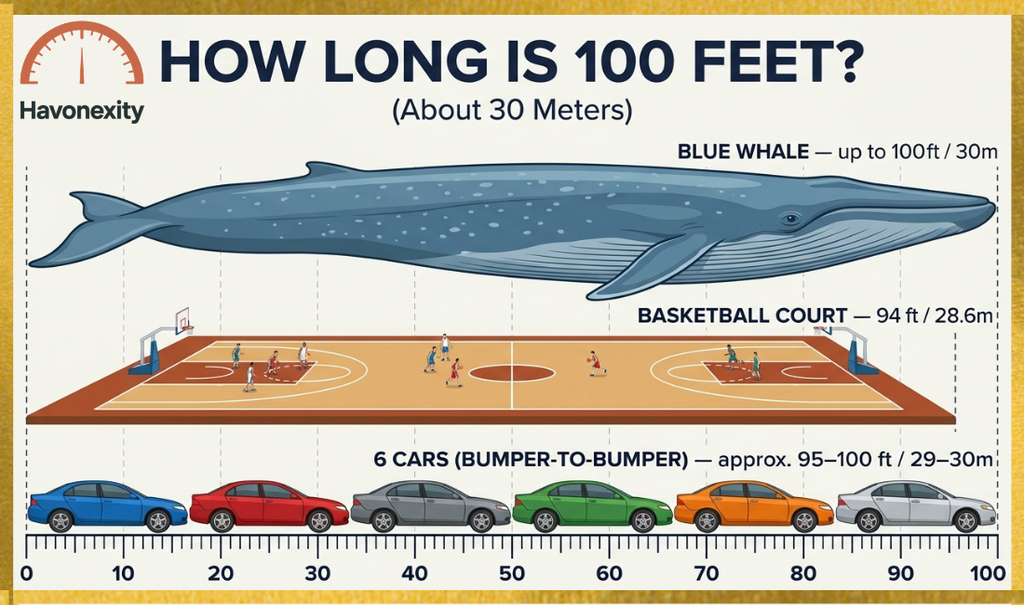
A Professional basketball court measures 94 feet long. That means 100 feet length is only about six feet longer than the entire playing surface.
If you’ve ever watched a basketball game or stepped inside a sports facility, you already know roughly what this distance feels like. Imagine standing at one baseline and walking slightly beyond the opposite end. That’s almost exactly 100 feet distance.
It’s one of the easiest ways to answer how far is 100 feet without pulling out a measuring tape.
2. Three School Buses Parked End to End
A standard School bus is around 35 feet long.
Line up Three school buses bumper to bumper and you’ll have approximately 105 feet. That’s extremely close to our target.
This 100 feet comparison is useful because school buses are familiar almost everywhere. Whether they’re parked outside schools or driving through neighborhoods, most people can instantly imagine this length.
3. About Ten Parked Cars
The Average car measures roughly 14 to 16 feet in length.
Place about Ten parked cars side by side in a straight line and you’ll end up with around 100 to 150 feet depending on vehicle size. Six or seven larger SUVs would cover a similar distance too.
This comparison works well in any parking lot, making it one of the most practical everyday measurements you’ll find.
4. Five Shipping Containers
A standard Shipping container is usually 20 feet long.
Arrange five containers in one row and you’ve created exactly 100 feet length.
You’ll often spot this setup inside a warehouse, port, or industrial facility, where rows of containers stretch across large storage yards. It’s an excellent size comparison for anyone working in logistics or construction.
5. A Giant Blue Whale
The Blue whale, the largest animal on Earth, can reach lengths approaching 100 feet.
Not every whale grows this large, of course, but the biggest individuals are astonishingly close.
If someone asks what animal is 100 feet long, this incredible marine giant is the closest real-world answer. Suddenly 100 foot length doesn’t seem so abstract anymore—it becomes something alive, swimming beneath the ocean surface.
6. The Width of a Large Residential Property
Many large Residential house lots have frontages close to 100 feet.
In some neighborhoods, the Property line stretches almost exactly this distance from one side to the other. Builders, surveyors, and real estate professionals often estimate lot sizes using this familiar measurement.
Understanding this property measurement can make home planning much easier than relying solely on numbers.
7. Around Six Utility Poles Apart
Most Utility pole, Telephone pole, or Power pole installations are spaced roughly 150 to 300 feet apart, though spacing varies.
So, 100 feet represents a little more than half the distance between many poles.
Electric companies use these measurements during cable planning, maintenance, and infrastructure design. It’s another useful outdoor distance comparison.
8. Almost Four Bowling Lanes
A regulation Bowling lane measures about 60 feet from the foul line to the head pin.
Add part of another lane and you’ll reach roughly 100 feet.
If you’ve ever visited a bowling center, you can probably imagine this without much effort. It’s another great example of sports dimensions helping improve distance estimation.
9. Slightly Longer Than a Tennis Court
A full Tennis court, including the Baseline and Run-off area, measures close to 120 feet overall.
That means 100 feet covers most of the court, stopping just before the far safety zone.
This makes tennis facilities another useful visual distance reference.
10. A Typical Office Hallway
Many large Commercial building complexes have long Office hallway sections measuring somewhere between 80 and 120 feet.
Walking from one end to another often takes only 20 to 25 seconds at a relaxed pace.
If you’ve worked inside hospitals, schools, or business offices, you’ve probably walked 100 feet countless times without realizing it.
11. A Short Walk Across a Freight Yard
Inside a Freight yard or Highway rest area, Semi-truck and Freight truck parking spaces extend over large areas.
Walking across several truck bays usually covers close to 100 feet distance.
Professionals involved in traffic planning, road safety, and transportation frequently estimate this kind of walking distance when designing layouts.
100 Feet Compared to Common Objects
People usually understand measurements faster when comparing them with familiar things.
| Object | Approximate Comparison |
|---|---|
| Basketball court | Slightly longer |
| Three school buses | Nearly equal |
| Five shipping containers | Exactly equal |
| Giant blue whale | Nearly equal |
| Ten parked cars | Close depending on size |
| Large house frontage | Similar |
| Office hallway | Similar |
| Bowling lanes | About four lanes |
These examples of 100 feet make length estimation much easier than memorizing numbers alone.
How Many Steps Is 100 Feet?
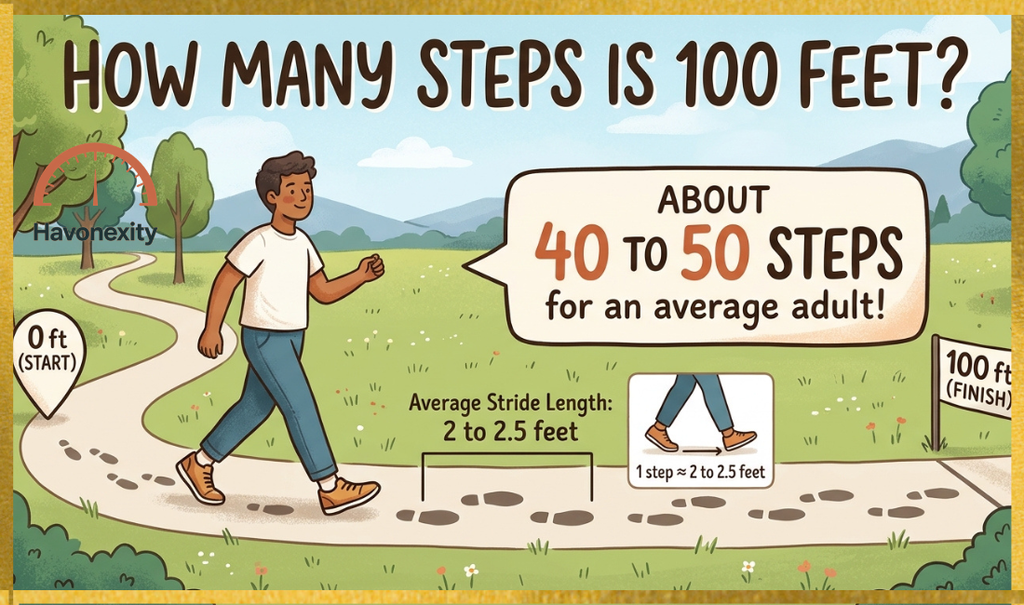
An average adult step measures around 2.5 feet.
That means walking 100 feet usually takes approximately 40 steps.
Of course, everyone’s stride is a little different. Taller people may reach the distance in fewer steps, while children may need quite a few more.
If you’ve searched how many steps is 100 feet or how long is a 100 foot walk, this estimate works surprisingly well.
How Far Can You Walk in 100 Feet?
Most people walk at roughly 3 to 4 miles per hour.
At that speed, covering 100 feet takes only about 20 seconds.
It feels much shorter than people often imagine. That’s because our brains tend to overestimate unfamiliar distances until we connect them with recognizable objects.
How to Measure 100 Feet
If you need accurate measurements, several methods work well.
- Use a measuring tape designed for outdoor projects.
- Count approximately 40 average walking steps.
- Use a laser distance calculator.
- Measure with a survey wheel.
- Open a mapping app with measuring tools.
- Use a length converter for quick unit conversion.
- Compare with known objects like shipping containers or basketball courts.
Each method provides a practical distance reference depending on your situation.
Why Real-World Comparisons Matter

Understanding measurements isn’t really about memorizing numbers. It’s about creating mental pictures.
Whether you’re estimating landscaping space, planning a building project, judging turning distance, checking stopping distance, or simply satisfying curiosity, real-world measurements improve human perception far better than raw figures.
That’s why comparing 100 feet measurement with school buses, basketball courts, blue whales, and cars sticks in your memory much longer.
Frequently Asked Questions
What does 100 feet look like?
It looks roughly like one professional basketball court, five shipping containers, or three school buses lined up together.
How many car lengths is 100 feet?
Using an average car length of about 15 feet, 100 feet equals around six to seven cars parked bumper to bumper.
What vehicle is 100 feet long?
Most single vehicles aren’t that long, but combinations involving a Semi-trailer and additional trailers can approach or exceed 100 feet depending on local transportation regulations.
How many houses equal 100 feet?
It depends on lot size, but one large residential property’s frontage often measures close to 100 feet.
Basketball court vs 100 feet
A basketball court measures 94 feet, making 100 feet only six feet longer.
Blue whale length comparison
The largest blue whales can grow close to 100 feet, making them one of nature’s best real-world comparison examples.
Telephone pole height comparison
Although Telephone pole heights vary, they’re generally much shorter than 100 feet. However, pole spacing outdoors can help estimate similar distances.
Frequently Asked Question
What Does 100ft Look Like
100 feet looks about as long as a professional basketball court, three school buses parked end to end, or five shipping containers lined up. These familiar objects make the distance much easier to picture.
How Far Is 100 Feet Visually
Visually, 100 feet is about a 20-second walk for most people or roughly 40 average steps. It’s a short distance that can be recognized using common landmarks and everyday objects.
100 Feet Example
A great 100 feet example is three school buses parked in a straight line or nearly one full basketball court. These comparisons help you quickly understand the length.
How Many Cars Is 100 Feet
Using an average car length of about 15 feet, 100 feet is equal to around 6 to 7 cars parked bumper to bumper. Larger vehicles may reduce the total number needed.
100 Feet Distance Examp
A simple 100 feet distance example is the length of five 20-foot shipping containers or the approximate length of a giant blue whale. These real-world examples make the measurement easy to visualize.
Read this blog https://havonexity.com/pringles-can-size/
Final Thoughts
Learning how long is 100 feet becomes much easier once you stop thinking only in numbers. Instead, picture three school buses, five shipping containers, a giant blue whale, or nearly one basketball court. Those images stick with you way longer than a conversion chart ever could, honestly.
Whether you’re estimating a property, planning a construction project, exploring measurement charts, comparing objects that are 100 feet long, or simply satisfying curiosity, these everyday examples of 100 feet provide practical context you’ll actually remember.
The next time someone asks what does 100 feet look like, you’ll probably smile a little, because instead of guessing, you’ll already have a handful of vivid comparisons ready to share.
