
Have you ever stood somewhere, looked ahead, and wondered, “Is that about fifty feet away?” It sounds like an easy distance until someone actually asks you to picture it.
Then your brain does this funny little thing where everything either becomes too short or way too long. That’s kinda normal, honestly.
Numbers by themselves are quiet. They don’t become meaningful until they borrow the shape of something familiar.
Understanding 50 feet length isn’t really about memorizing measurements. It’s about creating a picture your mind can keep using later.
Maybe you’re planning a backyard project, checking property boundaries, designing a garden, estimating the size of a truck, or just trying to answer a random question during a conversation.
Whatever brought you here, this guide will help you build a real mental image rather than just throwing numbers at you.
In this visual measurement guide, we’ll explore how long is 50 feet using everyday places, common objects, sports facilities, vehicles, buildings, and even nature. Along the way, we’ll cover simple conversions, practical comparisons, and helpful tips that make distance visualization much easier than staring at a tape measure for several minutes which, lets be honest, almost nobody enjoys.
| Measurement | 50 Feet Equivalent |
|---|---|
| Length | 50 feet (ft) |
| Meters | 15.24 m |
| Yards | 16.67 yd |
| Inches | 600 in |
| Walking Steps | About 20 steps |
| Average Cars | About 3 cars |
| School Bus | Slightly longer than a standard bus |
| Basketball Court | Equal to the court’s width |
| Semi-Truck Trailer | About the same length |
| Five-Story Building | Roughly the same height |
What Is 50 Feet?
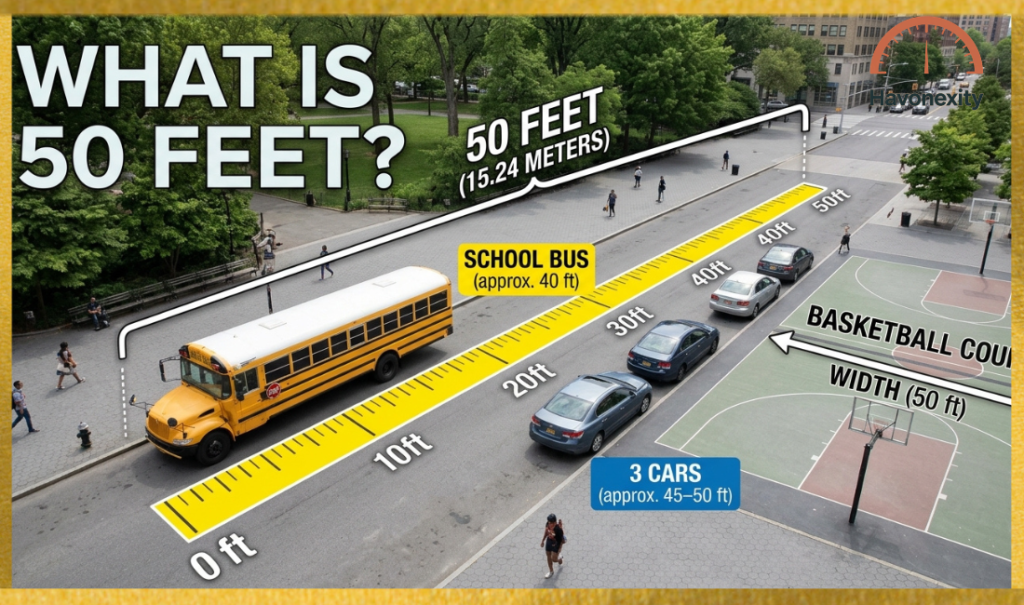
The simplest answer is that 50 feet is a moderate distance—long enough to notice but short enough to walk in only a few seconds.
Here are the most useful length conversion values:
| Measurement | Equivalent |
|---|---|
| Feet (ft) | 50 feet |
| Inches | 600 inches |
| Yards | 16.67 yards |
| Meters | 15.24 meters |
| Centimeters | 1,524 centimeters |
| Millimeters | 15,240 millimeters |
| Miles | 0.0095 miles |
Whether you use Imperial units or Metric units, these conversions make it easier to compare distances across different measurement systems. They’re also useful if you’re using a measurement calculator, planning construction work, or reading international specifications.
Still, numbers only tell part of the story. The real magic happens when you compare them with things you’ve already seen hundreds of times.
Why Visualizing 50 Feet Is Easier Than Measuring It
Most people don’t carry a measuring tape everywhere. Instead, they estimate distances using memory.
That’s why a good scale reference or real-world size comparison works so well. Once your brain remembers that a school bus is about this long or that a bowling lane stretches roughly that far, estimating future distances becomes surprisingly accurate.
Professional architects, photographers, surveyors, sports coaches, and construction workers often rely on these mental references too. It’s not guesswork exactly—it becomes trained observation.
50 Feet Length Comparison Using Everyday Examples
Below are ten practical everyday examples that create a much clearer picture of how long is 50 feet in real life.
1. A Standard School Bus
One of the easiest ways to understand 50 feet compared to a school bus is to imagine a full-sized standard school bus parked beside the road.
Most buses measure around 40 feet to 45 feet, depending on the model. A 50 feet comparison would extend several more feet beyond the front bumper, making it just a bit longer than the bus itself.
If you’ve ever waited outside a school while buses lined up, you’ve already seen something very close to this distance.
This makes buses one of the best real-world measurements for estimating longer spaces.
2. Nearly the Length of a Semi-Truck Trailer
A semi-truck trailer or truck trailer often measures close to 48 feet or 53 feet.
That means 50 feet sits almost perfectly between these common trailer sizes.
Loading docks, distribution centers, and highways are full of these trailers, making them an excellent object size comparison whenever you need to estimate fifty feet.
The next time one passes you on the highway, you’ll have a surprisingly accurate distance reference already stored in your head.
3. Around Three Average Cars
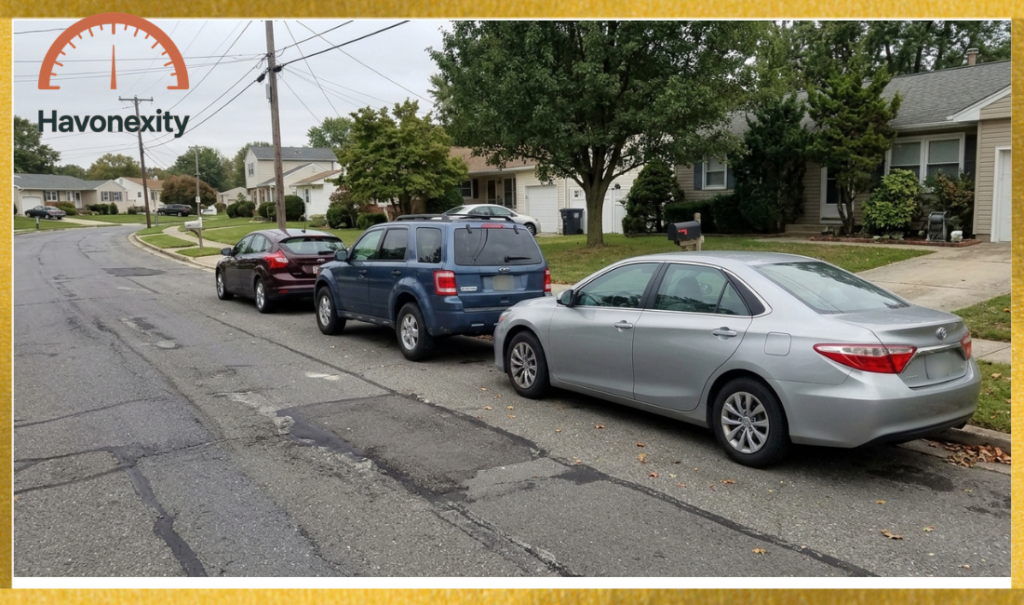
An average car is usually about 15 feet long.
Three parked cars lined up bumper to bumper measure roughly 45 feet. Add another few feet, and you’ve reached about 50 feet.
If the lineup includes an SUV, the total gets even closer.
This is one of the easiest objects that are 50 feet long comparisons because parking lots are everywhere.
4. Half the Width of an NBA Basketball Court
An official NBA basketball court measures 50 feet wide.
That means if you’re standing on one sideline and looking directly across to the opposite sideline, you’re looking almost exactly at 50 feet length.
It’s one of the cleanest examples because the measurement is standardized.
The basketball court width also includes areas where scorekeepers sit behind the PRO-LED basketball scorers table, helping people involved in sports naturally develop a sense of this distance.
5. Slightly Longer Than a Bowling Lane
A regulation bowling lane measures 60 feet from the foul line to the head pin.
Therefore, 50 feet reaches almost to the end but stops about 10 feet short.
If you’ve ever rolled a bowling ball, you’ve experienced nearly this exact distance without even realizing it.
It’s a fantastic indoor scale comparison because bowling lanes never change dimensions.
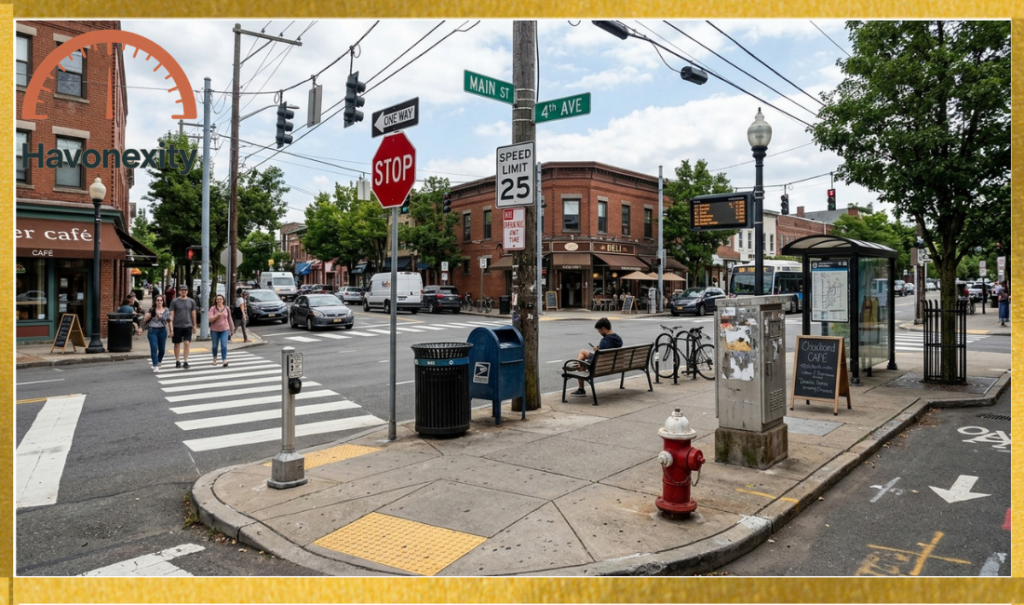
6. The Width of a Residential Street
Many neighborhood roads measure close to 40 feet, while wider residential streets approach 50 feet once traffic lanes and side spacing are included.
Standing on one sidewalk and looking toward the opposite curb often gives a realistic idea of 50 feet distance.
Urban planners and engineers use these measurement standards when designing neighborhoods that balance traffic flow with pedestrian safety.
7. About a Five-Story Building
A typical building story measures around 10 feet.
Multiply that by five floors and you get approximately 50 feet.
Looking upward can sometimes make measurements easier than looking outward.
Next time you’re standing beside a five-story building or small mid-rise building, imagine laying that height flat on the ground. That’s very close to fifty feet.
It’s a surprisingly effective height comparison and horizontal distance exercise.
8. Close to the Length of a Blue Whale
The blue whale, one of Earth’s largest animals, often grows between 70 and 100 feet.
Juveniles and smaller adults may measure closer to 50 feet.
Thinking about an enormous whale stretching across the ocean creates an unforgettable mental picture of this measurement.
Nature has a funny way of teaching geometry without anyone noticing.
9. Around Twenty Walking Steps
The average adult takes steps measuring roughly 2.5 feet per step.
That means 20 steps equals about 50 feet.
At an average walking speed, covering this distance only takes several seconds.
If someone asks, “How far is 50 feet to walk?” simply count about twenty comfortable steps.
It’s one of the easiest distance estimation techniques because you always have your own footsteps available.
10. The Height of Mature Trees
Many healthy oak trees and pine trees grow close to 50 feet before reaching much greater heights.
Looking at a mature tree gives a natural size reference that works whether you’re hiking, camping, or simply walking through a neighborhood park.
Tree heights vary, of course, but many commonly planted species eventually become excellent examples of fifty feet long when viewed vertically.
Nature quietly teaches measurements every single day. We just don’t usually notice it.
50 Feet Compared to Other Common Measurements
Sometimes comparisons become easier when placed beside similar distances.
| Measurement | Comparison |
|---|---|
| 15 feet | Small bedroom length |
| 40 feet | Typical school bus |
| 45 feet | Long trailer or bus |
| 48 feet | Standard truck trailer |
| 50 feet | Three cars or basketball court width |
| 53 feet | Common freight trailer |
| 60 feet | Regulation bowling lane |
| 164 feet | About 50 meters |
| 1,250 feet | Distance walked in about five minutes at 250 feet per minute |
Seeing nearby measurements helps improve size consistency whenever you’re estimating unfamiliar spaces.
Indoor References for Visualizing 50 Feet
Finding indoor examples is a bit trickier, but not impossible.
Large school hallways often stretch close to fifty feet between intersections.
Community recreation centers frequently have open areas approaching this distance.
Many hotel corridors extend around fifty feet before reaching elevators.
Some supermarket aisles are surprisingly close as well.
These familiar spaces become excellent indoor references whenever someone asks, “What does 50 feet look like?”
Outdoor References You See Every Day
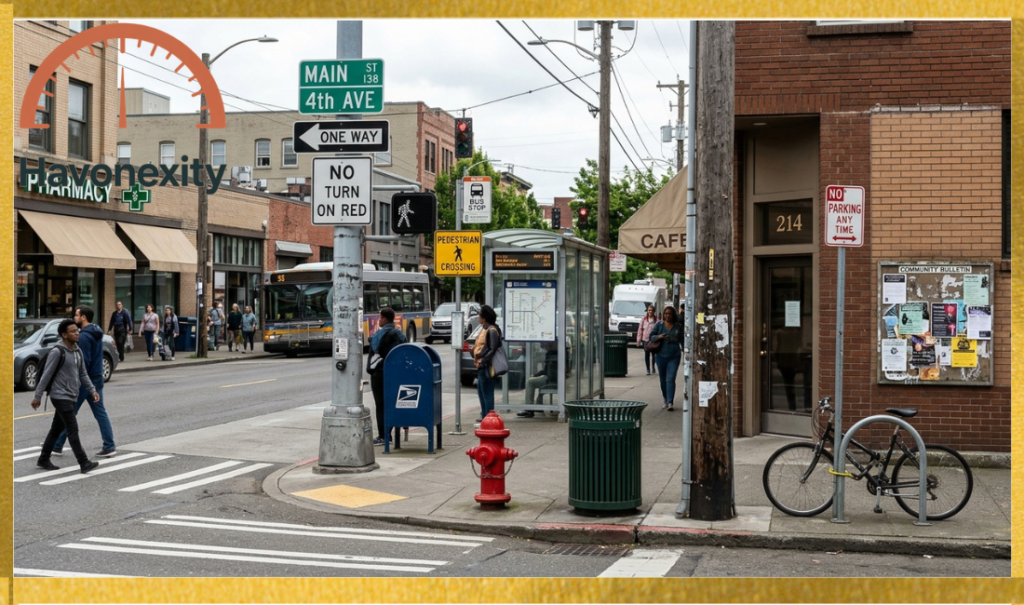
Outdoor comparisons are usually much easier.
You’ll regularly encounter:
- Three parked cars
- A standard school bus
- Residential street width
- Large trees
- Basketball courts
- Truck trailers
- Swimming pool areas
- Construction sites
- Parking lots
- Public parks
Once you begin paying attention, you’ll realize examples of 50 feet length appear almost everywhere.
Why People Need to Estimate 50 Feet
Accurate estimates are useful in far more situations than people expect.
You might need them when:
- Buying fencing materials.
- Measuring a backyard.
- Planning landscaping.
- Designing patios.
- Estimating sports practice areas.
- Parking trailers.
- Evaluating construction projects.
- Setting camera distances.
- Flying recreational drones where permitted.
- Planning outdoor events.
A reliable measurement guide saves time before precise tools are even needed.
Tips for Estimating 50 Feet Without Measuring
If you don’t have a tape measure nearby, try these simple tricks.
Remember that twenty average walking steps equal roughly fifty feet.
Picture three average cars parked bumper to bumper.
Imagine the width of an NBA basketball court.
Visualize a five-story building laid flat.
Think of a truck trailer parked beside a loading dock.
These visualization techniques quickly improve your accuracy over time.
Like any skill, estimation becomes easier with practice. Your first guess may be off by several feet, but after repeating these comparisons, you’ll be surprised how close you become.
Common Mistakes When Estimating Distance
Many people accidentally overestimate large open spaces.
Another common mistake is assuming objects look larger simply because they’re closer.
Perspective changes everything.
People also forget that different vehicles vary greatly in length. Not every bus, SUV, or trailer measures the same.
Using standardized references like basketball courts or bowling lanes generally produces more consistent estimates.
Frequently Asked Question
How Long Is 50 Feet
50 feet is equal to 600 inches, 16.67 yards, or 15.24 meters. It’s about the length of three average cars parked bumper to bumper or the width of an NBA basketball court.
How Long Is 50ft
50ft is a moderate distance that’s easy to picture using everyday objects. It’s slightly longer than a standard school bus and close to the length of a semi-truck trailer.
How Long Is 50 Feet Visually
Visually, 50 feet looks like about 20 average walking steps, three parked cars in a row, or the width of a basketball court. These familiar comparisons make the distance much easier to imagine.
How Long Is 50 Ft
50 ft measures 15.24 meters and is commonly used for estimating outdoor spaces, property dimensions, and construction projects. It can also be compared to the height of a five-story building.
How Much Is 50 Feet
50 feet equals 600 inches, 16.67 yards, 15.24 meters, 1,524 centimeters, and 15,240 millimeters. It’s a practical distance that can be visualized using common real-world examples like a school bus or three average cars.
Final Thoughts
Understanding 50 feet length becomes much simpler once you connect it with everyday life instead of memorizing numbers alone.
Whether you picture a standard school bus, three parked cars, the width of an NBA basketball court, a semi-truck trailer, or twenty walking steps, each comparison builds a stronger sense of scale.
The next time someone asks how long is 50 feet, you probably won’t think about 600 inches, 15.24 meters, or 16.67 yards first. You’ll picture something you’ve actually seen.
That’s how our brains naturally understand distance not through isolated figures, but through familiar experiences that quietly stick with us.
Keep these examples in mind whenever you need a quick estimate, whether you’re planning a project, exploring outdoors, comparing physical dimensions, or simply satisfying your curiosity.
Before long, 50 feet explained won’t feel like a measurement at all. It’ll feel like something you can actually see.
