
Have you ever looked across a driveway, watched a truck pull into a parking lot, or stood beside a tall building and wondered how long 20 feet really is? Measurements may look simple on paper, but visualizing them in everyday life can be surprisingly difficult.
Twenty feet is not an extremely long distance, but it is large enough to matter when planning a garage, choosing a vehicle, installing a swimming pool, or measuring a wall. The good news is that many familiar objects can help you understand this length without relying entirely on a measuring tape.
So, how long is 20 feet? It equals 240 inches, 6.096 meters, or approximately 6.1 meters. To make the measurement easier to imagine, you can compare it with a shipping container, a recreational boat, a delivery truck’s cargo box, or several smaller objects placed end-to-end.
In this guide, we’ll explore 19 real-life examples that help you visualize 20 feet. We’ll also cover unit conversions, simple measuring methods, construction applications, and frequently asked questions.
How Long Is 20 Feet? Understanding the Basic Measurement
Twenty feet is a standard unit of length in the imperial measurement system. It is commonly used in the United States for describing vehicle dimensions, building measurements, construction materials, and other everyday objects.
The measurement becomes easier to understand when you break it into smaller units. Since one foot equals 12 inches, multiplying 20 by 12 gives you 240 inches. In the metric system, 20 feet equals 6.096 meters, which is usually rounded to 6.1 meters for everyday estimates.
Imagine placing twenty 12-inch rulers in a straight line, with each ruler touching the next. Together, they would cover a distance of 20 feet.
20 Feet Conversion Chart
| Measurement Unit | Equivalent Length |
|---|---|
| Feet | 20 feet |
| Inches | 240 inches |
| Meters | 6.096 meters |
| Centimeters | 609.6 cm |
| Millimeters | 6,096 mm |
| Yards | Approximately 6.67 yards |
| Miles | Approximately 0.00379 miles |
| Kilometers | 0.006096 km |
These conversions are useful when comparing product specifications, reading building plans, or working with measurements from countries that use the metric system.
Remember that length, height, and width describe different dimensions. An object can be 20 feet long without being 20 feet tall or wide. Always identify the dimension you need before using a measurement for a project.
20 Feet in Real Life: 19 Everyday Examples
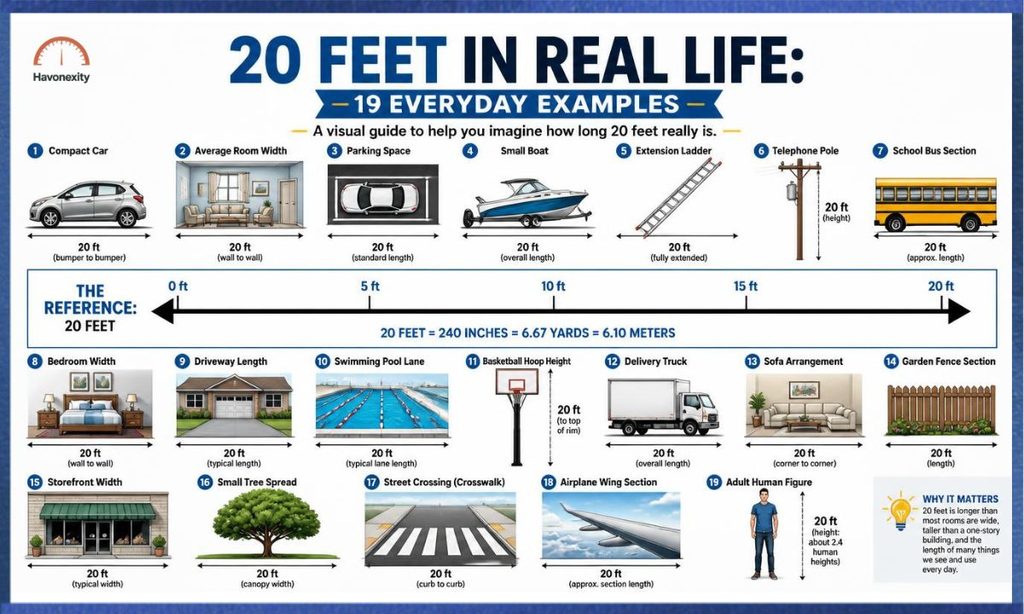
The easiest way to understand a measurement is to compare it with objects you already recognize. The following examples cover transportation, wildlife, construction, homes, and recreation.
Some examples measure approximately 20 feet, while others help you visualize the distance through height or combined lengths. Actual dimensions vary by model, design, and manufacturer, so use these comparisons as visual references rather than substitutes for accurate measurements.
1. A Standard 20-Foot Shipping Container
A standard 20-foot shipping container is one of the clearest examples of this length because its nominal size is included in its name. These steel containers are widely used in international shipping, warehouses, ports, and construction sites.
A typical standard container has an exterior length of approximately 20 feet. Its exterior width is commonly around 8 feet, and its height is often about 8 feet 6 inches, although specifications can vary.
Imagine a long steel container sitting beside a loading dock or resting on a cargo ship. Its rectangular shape gives you a practical way to visualize the distance.
Shipping containers are also used for storage, temporary workshops, and converted workspaces. However, their usable interior length is shorter than their exterior length because the walls and end structures take up space.
If you need a dependable reference for 20 feet, a container with verified dimensions is more useful than an object whose size varies significantly.
2. A Small School Bus
Some small school buses approach 20 feet in overall length, depending on their configuration. These vehicles are often used for smaller student groups, specialized transportation, and routes where a full-size school bus may be unnecessary.
Picture a short yellow school bus parked beside a passenger car. Its long body provides a familiar reference for understanding a distance of around 20 feet.
Not all school buses are the same size. Some compact models are shorter than 20 feet, while larger buses can be considerably longer. Their overall length depends on the chassis, seating capacity, and body design.
This comparison is useful when estimating space for vehicle parking, school transportation facilities, or neighborhood access. If you are planning a driveway or garage, check the specific bus dimensions rather than relying on its general category.
3. A Delivery Box Truck
A delivery box truck is another practical example of a 20-foot measurement. Some commercial trucks have cargo boxes approximately 20 feet long, making them useful references when estimating loading and storage space.
Imagine a moving company arriving at a house with furniture, boxes, and household appliances. The large rectangular cargo body gives you a clear visual impression of the distance.
One important detail is the difference between cargo-box length and total vehicle length. A truck with a 20-foot cargo box will usually be longer overall when the cab, bumper, and other components are included.
This distinction matters when hiring a moving truck, planning a loading area, or checking whether a commercial vehicle can enter a driveway. Always confirm the dimensions of the complete vehicle if parking clearance is important.
4. A Full-Size Pickup Truck
Some full-size pickup trucks measure close to 20 feet from bumper to bumper. Their overall length varies according to the model, cab style, bed length, and model year.
For example, certain configurations of popular full-size pickups can measure approximately 17 to 21 feet long. A longer pickup can therefore provide a useful visual reference for a 20-foot distance.
Imagine a large pickup parked in a driveway. The distance from its front bumper to its rear bumper may be close to the measurement you are trying to picture.
This comparison is especially helpful when estimating driveway length, garage space, or parking requirements. However, the vehicle’s length is not the same as the total space needed to park it comfortably. Additional clearance may be necessary at both ends.
If you are buying a vehicle or designing a parking area, use the manufacturer’s specifications instead of assuming every pickup truck is approximately 20 feet long.
5. A Pontoon Boat
A pontoon boat measuring around 20 feet from bow to stern offers another useful comparison. These recreational boats typically have a broad deck supported by flotation tubes and are designed for activities such as relaxing, sightseeing, and spending time on the water.
Unlike a narrow fishing boat, a pontoon boat often looks wide and spacious. Its width can make its length seem shorter than it really is, showing how an object’s shape affects our perception of size.
Imagine the boat resting beside a dock, with the front seating area at one end and the rear platform at the other. The complete vessel provides a practical reference for visualizing 20 feet.
Boat length matters when selecting a trailer, booking a marina slip, or arranging storage. Keep in mind that the advertised hull length may differ from the total length once accessories or an outboard motor are included.
6. An RV Camper or Small Recreational Vehicle
Some camper vans and compact recreational vehicles measure approximately 20 feet long. These vehicles combine transportation with sleeping and storage space, making them popular for road trips and camping.
Imagine a compact RV parked at a campsite. Inside, it might contain a sleeping area, storage compartments, and a small kitchen. Although the vehicle is relatively short compared with a large motorhome, its layout can make efficient use of the available space.
Certain Class B recreational vehicles fall around this length, but sizes vary considerably. Some models are shorter, while other camper vans and motorhomes are longer.
This example is helpful when planning campground reservations, parking, or home storage. Remember that bike racks, rear accessories, and other attachments can increase the total length beyond the vehicle’s main body.
7. A Small Fishing Boat
A fishing boat around 20 feet long provides another realistic way to understand this measurement. Boats of this size may be used on lakes, rivers, and certain coastal waters, depending on their construction and equipment.
Imagine an angler preparing fishing rods, organizing tackle boxes, and checking the boat before heading out. The length runs from the bow at the front to the stern at the rear.
Fishing boats come in many sizes. Some are much shorter than 20 feet, while larger offshore models can be considerably longer. A boat’s suitability also depends on its hull design, engine, passenger capacity, and intended water conditions.
If you plan to store a boat at home, remember that its trailer may add several feet to the total length. A 20-foot boat may therefore require a longer storage area than you initially expect.
8. A Giraffe’s Height
A giraffe provides a memorable way to imagine how tall 20 feet is. Adult giraffes vary in size, and some exceptionally tall individuals can approach or exceed this height.
Their long legs, elongated necks, and distinctive head structures create a silhouette that is easy to recognize. When a giraffe stands beside a tree, its head can appear surprisingly high above the ground.
Imagine a vertical line extending 20 feet upward. A particularly tall giraffe can help you appreciate how dramatic that height would look in a real setting.
There is an important distinction here: this example refers to height, not horizontal length. A giraffe’s height from the ground to the top of its head is different from the length of its body.
9. A Green Anaconda’s Length
The green anaconda is one of the world’s largest snakes by body mass. Large individuals can reach lengths around 20 feet, although reported maximum sizes vary and unusually large claims may not be well documented.
Green anacondas live in South American wetlands and waterways. Their long bodies often curve and coil rather than remain straight, which changes the amount of ground space they occupy.
Imagine a 20-foot snake stretched out in a straight line. It would cover the full distance from one end to the other. If the same snake were coiled, however, its body could fit within a much smaller area.
This example highlights the difference between an animal’s total length and the physical space it occupies at a particular moment.
For wildlife comparisons, it is best to distinguish documented measurements from exceptional claims. The actual size of an individual animal can vary considerably.
10. A Newborn Blue Whale
A newborn blue whale is enormous compared with most animals people encounter on land. Blue whale calves are commonly described as approximately 20 to 25 feet long at birth, so a newborn may equal or exceed the distance you are trying to visualize.
Blue whales are the largest animals known to have lived on Earth. Their calves grow rapidly while nursing on their mothers’ milk.
Imagine a newborn whale stretching across a distance of about 20 feet. Even at birth, this marine mammal can be as long as a large vehicle or a small recreational boat.
The exact length of a calf depends on the individual and the measurement reported. Nevertheless, this example offers a striking way to understand the scale of 20 feet in the natural world.
11. A 20-Foot Extension Ladder
Extension ladders are commonly sold in nominal lengths such as 16, 20, 24, and 28 feet. A ladder labeled 20 feet therefore offers a direct reference for this measurement.
Imagine a contractor preparing to reach the exterior of a building or inspect an area near a roof. The ladder creates a long, visible line that makes the measurement easier to understand.
However, a 20-foot extension ladder does not necessarily provide a safe working height of 20 feet. Its usable reach depends on its design, extension overlap, placement angle, and the height at which it is supported.
Safety is especially important when using ladders. Follow the manufacturer’s instructions and applicable safety guidance. For many extension-ladder setups, the commonly used 4-to-1 rule means positioning the base approximately one foot away from the wall for every four feet of ladder height to the upper support point.
Never position or extend a ladder simply to match a desired measurement.
12. A Residential Flagpole
A residential flagpole around 20 feet tall can be a noticeable feature in a front yard, school entrance, garden, or community space.
Imagine standing at the base of the pole and looking up toward the flag. Your eyes follow the vertical line, making it easier to appreciate how much height 20 feet represents.
Flagpoles are available in different heights and materials. The right option depends on the location, wind exposure, foundation, installation method, and any applicable local requirements.
A flagpole also demonstrates why it is important to distinguish horizontal length from vertical height. Both use feet as a unit of measurement, but they describe different dimensions.
If you are installing a flagpole, check the manufacturer’s recommendations and ensure the foundation and installation method are suitable for the location.
13. A Two-Story House
Some modest two-story houses have a height approaching 20 feet up to part of the roofline. The actual height depends on ceiling dimensions, floor construction, foundation elevation, and roof design.
Imagine standing across the street and looking from the ground floor toward the upper level. A vertical distance of around 20 feet can help you visualize the height of a compact residential structure.
However, two-story homes do not all have the same height. Ceiling heights vary, structural components occupy space between floors, and roof pitches can make the total exterior height higher or lower.
If you are estimating a building’s height for painting, renovation, or window replacement, measure the actual structure or consult its plans. A visual estimate is not reliable enough for work that depends on precise dimensions.
14. The Width of a Garage or Spacious Parking Bay
A width of 20 feet is a useful reference when thinking about garage design and vehicle parking. Some double garages are around this width or wider, while a typical single-car garage is often narrower.
Imagine two cars parked side-by-side. Their combined widths, together with the space required to open doors and move around, determine whether the garage feels comfortable or cramped.
A garage that measures 20 feet across does not necessarily provide 20 feet of completely usable space. Interior walls, cabinets, shelving, tools, and stored equipment can reduce the available width.
This comparison is helpful when planning a garage renovation or deciding where to place a workbench. Before purchasing cabinets or storage units, measure the clear interior dimensions and consider how much room you need to enter and exit each vehicle.
15. A Short Indoor Swimming Pool
A compact swimming pool can measure around 20 feet long, particularly in residential properties where outdoor or indoor space is limited.
Imagine a rectangular pool with one end about 20 feet from the opposite wall. This gives you a clear idea of the distance a swimmer would travel from one end to the other.
A 20-foot pool is relatively short for continuous lap swimming, so swimmers may need to turn frequently. However, it can still be useful for casual swimming, water exercise, and cooling off during hot weather.
The pool’s practical value depends on its depth, width, circulation system, and intended use. Planning also requires enough space for safe access, walking surfaces, drainage, and maintenance equipment.
If you are considering installing a pool, confirm the available space and any applicable safety or building requirements before making a decision.
16. Four Five-Foot Park Benches
A single park bench is usually much shorter than 20 feet, but several benches can help you visualize the distance when placed end-to-end.
For example, four benches measuring five feet each would have a combined length of exactly 20 feet:
5 feet × 4 benches = 20 feet
Imagine four benches arranged in a straight line along a park pathway. Together, they provide a simple visual reference for the full distance.
This comparison is useful when planning a garden, public seating area, or outdoor recreational space. It also demonstrates how a large measurement can be divided into smaller, familiar sections.
In actual parks, benches are normally separated by gaps. If you are estimating the space required for a seating area, account for those gaps as well as the length of each bench.
17. A Long Garage Wall
A garage wall measuring 20 feet across offers a helpful reference for storage and home improvement projects. It provides a substantial stretch of wall for shelving, cabinets, tools, or a workbench.
Imagine walking from one corner of a garage to a point about 6.1 meters away. That distance is approximately 20 feet.
However, the full wall length may not be available for storage. Doors, windows, electrical panels, and wall-mounted equipment can interrupt the space. Deep shelving can also reduce the floor area available for vehicles or movement.
If you are organizing a garage workshop, draw a simple floor plan before buying storage units. Measure the wall and mark any obstructions so you can select equipment that fits without blocking access.
18. A Parking Space
Twenty feet is close to the length of many parking spaces designed for passenger vehicles, although the exact dimensions depend on local standards and the type of parking facility.
Imagine a vehicle parked between two painted boundary lines. A parking space measuring around 18 to 20 feet long gives you a practical reference for understanding the distance between the front and rear boundaries.
The dimensions of parking spaces vary by location, layout, and intended vehicle type. A space that works well for a compact car may feel restrictive for a large pickup truck, especially when walls or other obstacles are nearby.
If you are designing a driveway, parking area, or garage entrance, consult the relevant local standards and measure the actual space. Do not rely on a general estimate when vehicle access and safety depend on the available clearance.
19. Two Basketball Hoop Heights
A regulation basketball rim is positioned 10 feet above the playing surface. This makes it a familiar reference for understanding vertical measurements.
If you imagine two vertical sections, each measuring 10 feet, stacked one above the other, their combined height is 20 feet.
The basketball hoop provides a useful starting point because its regulation rim height is widely recognized. You can picture the rim at the 10-foot mark and imagine another equal distance extending upward to reach 20 feet.
This example refers to vertical height, not the length of the hoop itself. The support pole and backboard assembly may have different dimensions depending on the equipment design.
What Does 20 Feet Look Like Compared With Common Objects?
After exploring these 19 examples, it helps to compare them side by side. Some are direct references to a 20-foot length, while others illustrate the measurement through height or combined dimensions.
| Object or Reference | Comparison With 20 Feet |
|---|---|
| Standard 20-foot shipping container | Approximately 20 feet long externally |
| Small school bus | Some models approach this length |
| Delivery box truck | Some cargo boxes measure around 20 feet |
| Full-size pickup truck | Certain configurations are close to 20 feet long |
| Pontoon boat | Many recreational models are near 20 feet |
| Small fishing boat | Some models measure around 20 feet |
| Giraffe | Some individuals approach 20 feet in height |
| Green anaconda | Large individuals may reach around 20 feet long |
| Newborn blue whale | Often approximately 20–25 feet long |
| Extension ladder | Available in a nominal 20-foot size |
| Residential flagpole | Some models are around 20 feet tall |
| Two-story house | Some structures approach 20 feet in height |
| Compact swimming pool | Some pools measure around 20 feet long |
| Four five-foot benches | Combined length equals 20 feet |
| Basketball rim height | Two 10-foot sections equal 20 feet |
The most dependable comparisons are objects with known dimensions, such as a specified shipping container, ladder, or set of five-foot benches. Animals, houses, vehicles, and recreational equipment vary in size, so they are better treated as approximate visual references.
How Many Inches, Meters, and Centimeters Are in 20 Feet?
Converting 20 feet into other units is straightforward when you know the basic measurement relationships.
- 20 feet in inches: 20 × 12 = 240 inches.
- 20 feet in meters: 20 × 0.3048 = 6.096 meters.
- 20 feet in centimeters: 6.096 × 100 = 609.6 centimeters.
- 20 feet in millimeters: 609.6 × 10 = 6,096 millimeters.
- 20 feet in yards: 20 ÷ 3 = approximately 6.67 yards.
- 20 feet in kilometers: 20 × 0.0003048 = 0.006096 kilometers.
For everyday estimates, 6.1 meters is easier to remember than 6.096 meters. However, when ordering materials, comparing product specifications, or working from technical drawings, use the level of precision required for the task.
Also, check whether a listed measurement is nominal, rounded, or an exact specification. Two products described as 20 feet long may not have identical dimensions if their manufacturers measure them differently.
How Far Is 20 Feet When You’re Walking?
For most people, 20 feet is a short walking distance. Depending on your stride length, it may take approximately seven to ten ordinary steps to cover it.
Someone with a longer stride may need fewer steps, while a child or a person taking shorter steps may need more. Walking speed does not determine the distance covered by each step on its own; stride length also matters.
If you need a quick estimate, walk across a familiar room or driveway and count your steps. You can compare the result with a known distance to develop a rough personal reference.
However, counting steps is not an accurate measuring method. Use a measuring tape or laser distance meter when precision matters, especially for construction, cutting materials, installing equipment, or planning a permanent structure.
How to Measure 20 Feet Without Special Tools
Sometimes you need to estimate a distance before you can find a measuring tape. Several simple methods can help you get close to 20 feet.
1. Use Your Walking Stride
If you know that your ordinary step covers roughly 2 to 2.5 feet, eight to ten steps may bring you close to 20 feet. This is only an estimate because your step length changes with your pace, posture, and surroundings.
2. Count Familiar Objects
Look for objects with known dimensions. Four five-foot sections placed end-to-end equal 20 feet. This method works best when the objects are measured accurately and placed in a straight line without gaps.
3. Use a Known Room Dimension
A room, garage, or wall with documented measurements can help you estimate a nearby distance. Make sure you are comparing the correct dimension and not confusing the room’s width with its length.
4. Check a Scaled Floor Plan
For home improvement projects, a floor plan with a reliable scale can help you visualize the available space. Be careful with printed drawings because resizing a plan can change its scale and make measurements inaccurate.
5. Choose an Appropriate Measuring Tool
A measuring tape is useful for straight, accessible distances. A laser distance meter can be more convenient for longer indoor measurements. Outdoor measurements may require additional care around obstacles and uneven surfaces.
Remember that estimates are not substitutes for precise measurements. If a mistake could affect safety, construction quality, or an expensive purchase, verify the distance with a suitable measuring tool.
Is 20 Feet a Common Construction Measurement?
Yes, 20 feet appears in many construction, storage, transportation, and design contexts. It may describe the nominal length of a ladder, the exterior length of a shipping container, a section of a building, or a dimension shown on a plan.
However, there is no universal rule that every garage, wall, room, or parking area should measure 20 feet. The appropriate dimensions depend on the intended use, available space, materials, local requirements, and safety considerations.
For example, a 20-foot structural span may require engineering calculations to determine which beams, supports, or materials are suitable. Knowing the distance alone does not establish whether a particular structure can safely carry a load.
The same principle applies to home and outdoor projects. A space that appears large enough for a swimming pool may still need additional room for access, drainage, equipment, and safe walking surfaces.
Use visual comparisons to understand the scale, but rely on accurate measurements and professional guidance when the project requires them.
Frequently Asked Questions About 20 Feet
How long is 20 feet in simple terms?
Twenty feet equals 240 inches or 6.096 meters, which is approximately 6.1 meters. It is close to the length of some full-size pickup trucks, recreational boats, and standard shipping containers.
What objects are 20 feet long?
Examples include standard 20-foot shipping containers, some delivery-truck cargo boxes, certain pickup trucks, some pontoon and fishing boats, and extension ladders with a nominal length of 20 feet. Exact dimensions vary by model and specification.
How tall is 20 feet compared with a basketball hoop?
A regulation basketball rim is 10 feet above the playing surface. Therefore, 20 feet is twice the rim’s height when measured vertically from the same starting level.
How many steps does it take to walk 20 feet?
It may take approximately seven to ten ordinary steps, depending on your stride length. This estimate is not precise enough for construction or other tasks requiring accurate measurements.
Can I visualize 20 feet without a measuring tape?
Yes. You can imagine a standard 20-foot shipping container, compare the distance with a known ladder, place four five-foot sections end-to-end, or estimate the distance using your walking stride. For accuracy, use a measuring tool.
How many park benches equal 20 feet?
If each bench is five feet long, four benches placed end-to-end equal 20 feet. Actual bench lengths vary, so measure the specific benches if the result needs to be precise.
Is 20 feet the same as 6 meters?
No. Twenty feet equals 6.096 meters, making it 0.096 meters, or 9.6 centimeters, longer than 6 meters. The difference may be minor for a rough estimate but can matter in technical work.
Is 20 feet considered a long distance?
It depends on the situation. Twenty feet is short compared with a road or sports field, but it can be a substantial distance inside a small room, across a driveway, or along a garage wall.
How many yards are in 20 feet?
Twenty feet equals approximately 6.67 yards because one yard contains three feet. Divide 20 by 3 to calculate the conversion.
Is a 20-foot ladder safe for reaching a height of 20 feet?
Not necessarily. A ladder’s nominal length is not the same as its safe working reach. Extension overlap, positioning, angle, and the ladder’s instructions all affect how it should be used.
Conclusion: Making Sense of 20 Feet in Everyday Life
Understanding how long 20 feet is becomes much easier when you connect the measurement to familiar objects. A standard shipping container, a recreational boat, a delivery truck’s cargo box, or four five-foot benches can help you picture the distance. A tall giraffe, a residential flagpole, or two basketball-rim heights can provide additional references for understanding the same measurement vertically.
The best comparison depends on what you are trying to do. If you are planning a garage, consider vehicle dimensions and parking clearance. If you are working on a home improvement project, measure the actual wall, floor, or opening. If you are simply curious, everyday objects can make the number easier to remember.
Keep the basic conversion in mind: 20 feet equals 240 inches, 6.096 meters, or approximately 6.1 meters. This simple reference can help you estimate distances, compare products, and understand measurements in everyday life.
Visual comparisons are useful for building spatial awareness, but they should not replace accurate measurements when safety, construction, or purchasing decisions depend on exact dimensions.
Which of these 19 examples helped you visualize 20 feet most clearly? Share your favorite comparison or your own method for estimating distances.
